



You open Instagram to check one thing, and forty minutes later you're deep in a stranger's vacation photos with no memory of why you reached for your phone. If that sounds familiar, you're living with what most people call Instagram addiction, and it isn't a character flaw. The app was built to hold your attention, and blaming yourself misses the point. You don't have to quit forever to fix it either. Part of the answer is changing how you check specific profiles, which is why I'll get to an anonymous Instagram profile viewer below.
Is Instagram Addictive, or Is It Just a Habit?
Is Instagram addictive, or just a sticky habit? It's addictive, and on purpose. The people who build these apps run experiments on which layouts and reward timings keep you tapping, then keep whatever wins. That's not a conspiracy theory. It's the business model.
The engine underneath is the dopamine loop. Your brain hands you a small reward when something feels good, and Instagram doles those out unpredictably, the way a slot machine does. Sometimes a refresh brings a pile of likes, sometimes nothing, and that uncertainty is what makes it hard to set down.
So why is Instagram so addictive next to a plain weather app? It stacks validation from likes, constant visual novelty, FOMO, and real-time feedback that never quite ends into one endless feed. That stack is the whole answer to why is Instagram so addictive, and it's why calling it Instagram addiction rather than a bad habit is fair.
Why Am I Addicted to Instagram? The Real Reasons
The pulls are wired into being human, not into some flaw in you, and naming them takes back a little of their power. Comparison is the loudest of them. You scroll the best ten seconds of a hundred other lives and measure your ordinary Tuesday against all of it.
Validation turns likes and views into a scoreboard for your worth, so a low-scoring post can sting more than it should. FOMO keeps you refreshing so you don't miss the thing everyone's discussing, and boredom fills every idle gap until stillness itself starts to feel wrong. For a lot of people it runs deeper than habit, since your profile becomes part of how you see yourself, and stepping back feels like stepping away from your own identity. If you feel addicted to Instagram, that doesn't make you weak. It makes you a normal person facing a product built to be hard to leave.
How Instagram Addiction Affects Your Mental Health
Instagram addiction rarely shows up head-on. It leaks in sideways, through your sleep, your focus, and your mood. Start with the raw time. Statista's February 2026 data on daily use by app puts the global Instagram average at [X hr Y min] a day, and that has to come from somewhere, usually sleep and focus.
Late-night scrolling pushes back when you fall asleep, and broken sleep drags on everything the next day. Comparison feeds anxiety and wears down self-esteem over weeks. Your attention takes a hit too, because a feed trains your brain to expect a jolt every few seconds, so slower work starts to feel unbearable. The clearest sign someone is addicted to Instagram is one people say out loud: they feel worse after a session, then reach for it again an hour later. That isn't a reason for shame. It's a reason to change the setup.
How to Break Instagram Addiction? What Works
The real answer to how to stop Instagram addiction is friction, not force. You don't need more discipline. You need the automatic reach to be a little harder, so your brain gets a beat to decide.
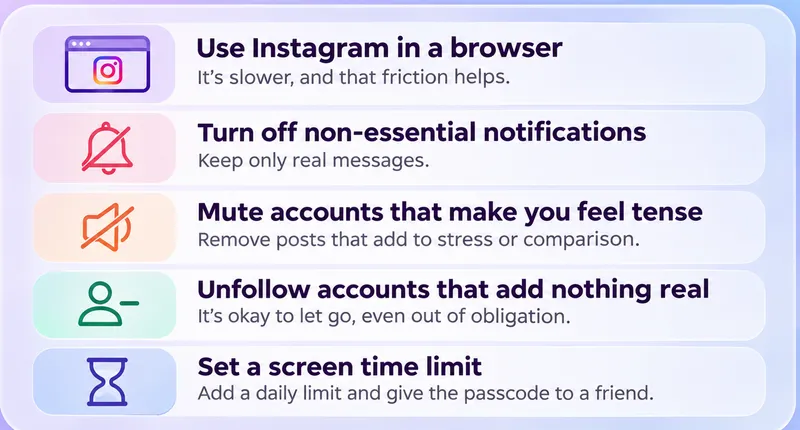
Delete the app but keep your account. This one change does more than any pep talk, because opening a browser and logging in adds just enough resistance to break the reflex. Turn off every notification that isn't a message from a real person, and set real windows for it, like fifteen minutes after lunch, that you treat like appointments.
Then swap the habit for something your hands can do: a walk, a book left on the couch, a sketchpad. The honest path to how to stop being addicted to Instagram starts even earlier, with one plain week of tracking your screen time before you change anything, so you know the real number you're working with. Tell someone you trust what you're doing, too. Accountability is dull, and it works.
How to Stop Instagram Addiction Without Quitting Forever
Most people don't want to delete their account, and they shouldn't have to. The trick to how to stop using Instagram compulsively, without deleting anything, is to make Instagram clunkier to use on purpose.
Use it only in a browser. It's slower, it nags you to install the app, and that friction is the feature, not the bug. Mute anyone whose posts leave you tense, and you'll feel the difference inside a week. Unfollow accounts that add nothing real to your day, even the ones you keep out of vague obligation. If you want a firm ceiling, set a screen time limit and hand the passcode to a friend so you can't extend it at midnight. None of this is cold turkey. It's steady reduction, which is the version that sticks.
The Hidden Trigger: Checking Other People's Profiles
One behavior pulls people back more than any other, and it almost never gets named: checking one specific person's profile. An ex, a crush, a competitor, someone you're worried about. This kind of checking is sticky because it feels purposeful instead of mindless, so it slips right past the guilt ordinary scrolling brings.
The problem is the delivery. You open Instagram for one account, the feed is sitting right there, and a thirty-second check turns into a lost half hour. There's no single trick for how to get rid of Instagram addiction, but this piece of it has a clean fix. Separate the need to check from the need to open Instagram at all.